
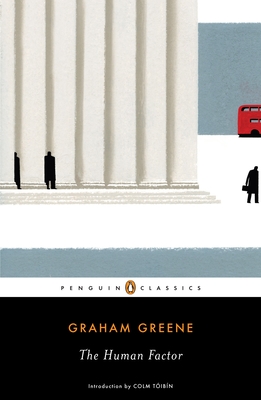
Description
Maurice Castle is a high-level operative in the British secret service during the Cold War. He is deeply in love with his African wife, who escaped apartheid South Africa with the help of his communist friend. Despite his misgivings, Castle decides to act as a double agent, passing information to the Soviets to help his in-laws in South Africa. In order to evade detection, he allows his assistant to be wrongly identified as the source of the leaks. But when suspicions remain, Castle is forced to make an even more excruciating sacrifice to save himself. Originally published in 1978, The Human Factor is an exciting novel of espionage drawn from Greene’s own experiences in MI6 during World War II, and ultimately a deeply humanistic examination of the very nature of loyalty. This edition features a new introduction by Colm Tóibín.
For more than seventy years, Penguin has been the leading publisher of classic literature in the English-speaking world. With more than 1,700 titles, Penguin Classics represents a global bookshelf of the best works throughout history and across genres and disciplines. Readers trust the series to provide authoritative texts enhanced by introductions and notes by distinguished scholars and contemporary authors, as well as up-to-date translations by award-winning translators.Binding Type: Paperback
Contributors: Graham Greene,Colm Toibin (Introduction by)
Published: 09/30/2008
Publisher: Penguin Publishing Group
ISBN: 9780143105565
Pages: 288
Weight: 0.50lbs
Size: 0.70″ H x 7.70″ L x 5.10″ W
About the Author
Graham Greene (1904-1991), whose long life nearly spanned the length of the twentieth century, was one of its greatest novelists. Educated at Berkhamsted School and Balliol College, Oxford, he started his career as a sub-editor of The Times of London. He began to attract notice as a novelist with his fourth book, Orient Express, in 1932. In 1935, he trekked across northern Liberia, his first experience in Africa, recounted in A Journey Without Maps (1936). He converted to Catholicism in 1926, an edifying decision, and reported on religious persecution in Mexico in 1938 in The Lawless Roads, which served as a background for his famous The Power and the Glory, one of several “Catholic” novels (Brighton Rock, The Heart of the Matter, The End of the Affair). During the war he worked for the British secret service in Sierra Leone; afterward, he began wide-ranging travels as a journalist, which were reflected in novels such as The Quiet American, Our Man in Havana, The Comedians, Travels with My Aunt, The Honorary Consul, The Human Factor, Monsignor Quixote, and The Captain and the Enemy. In addition to his many novels, Graham Greene wrote several collections of short stories, four travel books, six plays, two books of autobiography–A Sort of Life and Ways of Escape–two biographies, and four books for children. He also contributed hundreds of essays and film and book reviews to The Spectator and other journals, many of which appear in the late collection Reflections. Most of his novels have been filmed, including The Third Man, which the author first wrote as a film treatment. Graham Greene was named Companion of Honour and received the Order of Merit among numerous other awards.
Reviews
There are no reviews yet.