
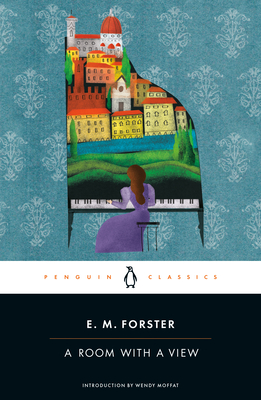
Description
E.M. Forster’s beloved novel of forbidden love, culture clash, and the confines of Edwardian society
Visiting Florence with her prim and proper cousin Charlotte as a chaperone, Lucy Honeychurch meets the unconventional, lower-class Mr. Emerson and his son, George. Upon her return to England, Lucy becomes engaged to the supercilious Cecil Vyse, but she finds herself increasingly torn between the expectations of the world in which she moves and the passionate yearnings of her heart. More than a love story, A Room with a View (1908) is a penetrating social comedy and a brilliant study of contrasts – in values, social class, and cultural perspectives – and the ingenuity of fate. In her illuminating introduction, Forster biographer Wendy Moffat delves into the little-known details of his life before and during the writing of A Room with a View, and explores the way the enigmatic author’s queer eye found comedy in the clash between English manners and the unsettling modern world, encouraging his reader to recognize and overcome their prejudice through humor. This edition also contains new suggestions for further reading by Moffat and explanatory notes by Malcolm Bradbury. For more than seventy years, Penguin has been the leading publisher of classic literature in the English-speaking world. With more than 1,700 titles, Penguin Classics represents a global bookshelf of the best works throughout history and across genres and disciplines. Readers trust the series to provide authoritative texts enhanced by introductions and notes by distinguished scholars and contemporary authors, as well as up-to-date translations by award-winning translators.Binding Type: Paperback
Contributors: E. M. Forster,Wendy Moffat (Introduction by),Malcolm Bradbury (Notes by)
Published: 08/01/2000
Publisher: Penguin Classics
ISBN: 9780141183299
Pages: 240
Weight: 0.37lbs
Size: 0.48″ H x 7.76″ L x 5.09″ W
About the Author
E. M. Forster was born in late-Victorian London in 1879 and died in 1970. Educated at King’s College, Cambridge, Forster made his name as a writer before the First World War, publishing four well- received novels: Where Angels Fear to Tread (1905), The Longest Journey (1907), A Room with a View (1908), Howards End (1910) and a collection of short stories, The Celestial Omnibus (1911). For almost fifty years after A Passage to India (1924), Forster ceased publishing fiction. A public intellectual and pungent social critic, Forster championed liberal beliefs, protesting fascism, the British occupation of Egypt and India, communism, Cold War militarism, censorship, anti-Semitism, and racism. His advocacy took many forms. Forster was a pioneer on the BBC’s India Service and published influential nonfiction, including Two Cheers for Democracy (1951) and Aspects of the Novel (1927). He experimented with travel writing and biography, and (with Eric Crozier) wrote the libretto for Benjamin Britten’s opera Billy Budd (1951). Since the posthumous publication of Maurice (written in 1914, published in 1971) and The Life to Come and Other Stories (1972), Forster has been rediscovered and reappraised as a prophetic writer of queer fiction.
Reviews
There are no reviews yet.