
Description
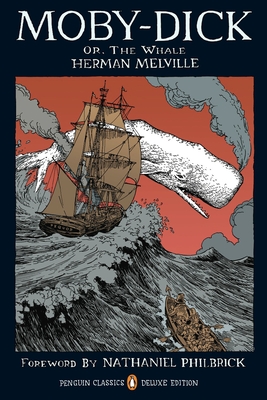
Herman Melville’s masterpiece of obsession and the untamed sea, one of the greatest works of imagination in literary history–a deluxe edition featuring a Foreword by Nathaniel Philbrick and cover art by Tony Millionaire.
This edition features the Northwestern-Newberry edition of Melville’s text, approved by the Center for Scholarly Editions and the Center for Editions of American Authors of the MLA.
Nominated as one of America’s best-loved novels by PBS’s The Great American Read
Binding Type: Paperback
Contributors: Herman Melville,Nathaniel Philbrick (Foreword by),Tony Millionaire (Illustrator)
Published: 10/01/2009
Publisher: Penguin Classics
ISBN: 9780143105954
Pages: 672
Weight: 1.52lbs
Size: 1.73″ H x 8.58″ L x 5.42″ W
About the Author
Herman Melville was born in August 1, 1819, in New York City, the son of a merchant. Only twelve when his father died bankrupt, young Herman tried work as a bank clerk, as a cabin-boy on a trip to Liverpool, and as an elementary schoolteacher, before shipping in January 1841 on the whaler Acushnet, bound for the Pacific. Deserting ship the following year in the Marquesas, he made his way to Tahiti and Honolulu, returning as ordinary seaman on the frigate United States to Boston, where he was discharged in October 1844. Books based on these adventures won him immediate success. By 1850 he was married, had acquired a farm near Pittsfield, Massachussetts (where he was the impetuous friend and neighbor of Nathaniel Hawthorne), and was hard at work on his masterpiece Moby-Dick. Literary success soon faded; his complexity increasingly alienated readers. After a visit to the Holy Land in January 1857, he turned from writing prose fiction to poetry. In 1863, during the Civil War, he moved back to New York City, where from 1866-1885 he was a deputy inspector in the Custom House, and where, in 1891, he died. A draft of a final prose work, Billy Budd, Sailor, was left unfinished and uncollated, packed tidily away by his widow, where it remained until its rediscovery and publication in 1924.



Reviews
There are no reviews yet.